The short answer
Reiki is a hands-on (or hands-off) energy healing practice in which a trained practitioner channels universal life energy to support your body's natural ability to relax, release tension, and restore balance. The word itself comes from two Japanese words: rei (universal) and ki (life energy).
It was developed in Japan in 1922 by Mikao Usui and has since spread to every continent, with hundreds of thousands of practitioners worldwide. Reiki is not massage, not psychotherapy, and not medicine. It is a complementary practice — something people use alongside conventional care, not instead of it.
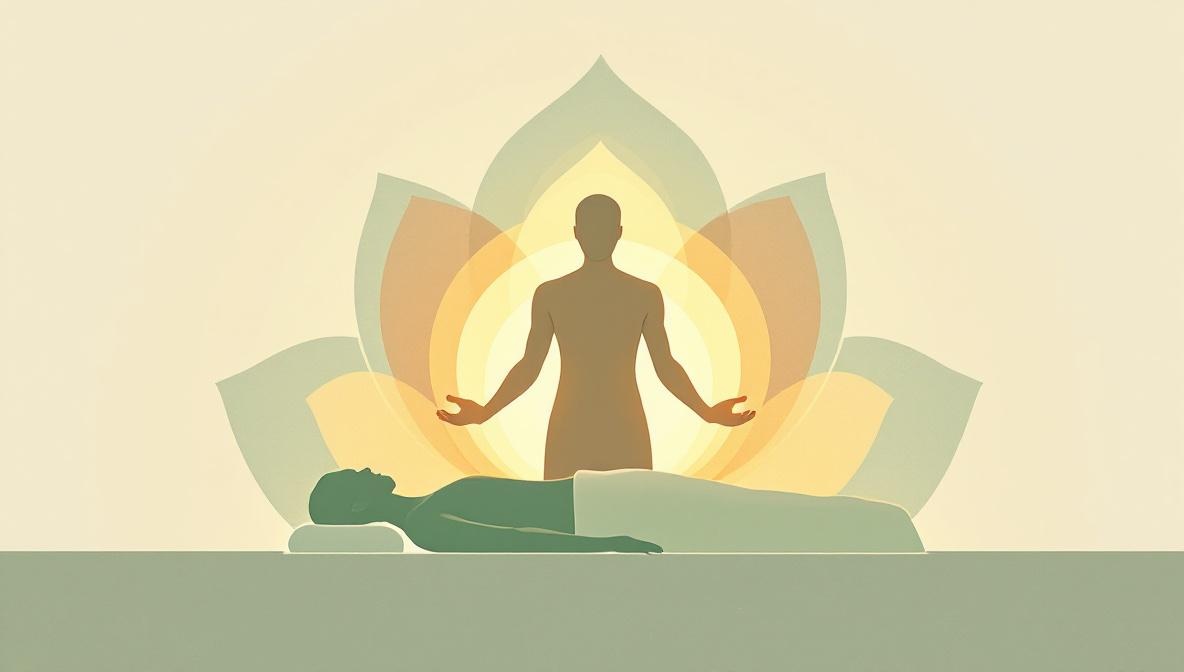
During a session, the practitioner places their hands lightly on or just above specific areas of your body. You remain fully clothed, lying on a treatment table or sitting in a chair. Most people describe the experience as deeply calming — like the feeling of drifting into sleep while still being aware.
How a Reiki session actually works
Whether in person or online, a Reiki session follows a predictable structure. Knowing what to expect removes most of the uncertainty.
1. Brief conversation. The session starts with a short check-in. The practitioner asks how you're feeling, whether you have any specific concerns (stress, pain, emotional heaviness), and what you'd like to focus on. This is not therapy — it's orientation.
2. You lie down or sit comfortably. For in-person sessions, you lie fully clothed on a padded table, often with a blanket. For distance sessions, you find a quiet spot at home — couch, bed, floor cushion — whatever allows you to close your eyes and relax.
3. The practitioner works through hand positions. In person, they place their hands lightly on or just above your head, shoulders, chest, abdomen, and legs — a standard sequence that covers the body's major energy centres. In a distance session, they work through the same positions energetically, guiding you by voice.
4. You rest. Your only job is to breathe and receive. Most people close their eyes. Some fall asleep — and that's perfectly fine.
5. Closing and debrief. The practitioner gently signals the end of the session. There's a short conversation about what you noticed (sensations, emotions, images) and any self-care suggestions for the next day or two — drink water, rest if needed, pay attention to your dreams.
Who is Reiki for?
Reiki appeals to a wide range of people, but it works best for those who come to it with realistic expectations. Here's who tends to benefit most.
Reiki is a good fit if:
- You carry chronic stress or tension and want a practice that helps your nervous system settle — not just your mind.
- You're going through a difficult period — grief, transition, burnout — and want something gentle alongside whatever else you're doing (therapy, medical care, rest).
- You're open to the idea that the body holds tension and emotion, even if you can't fully explain it scientifically.
- You want to try a complementary practice that is non-invasive, requires no preparation, and has essentially no side effects.
Reiki is probably not the best fit if:
- You need a clinical treatment for a diagnosed condition. Reiki is complementary — it is not a substitute for medical or psychological care.
- You require hard scientific proof before trying anything. The evidence base for Reiki is growing but still limited — mostly small-scale studies on relaxation and pain perception.
- You're looking for something physically active or verbally interactive. Reiki is quiet, still, and receptive.
What can you realistically expect?
People who receive Reiki most commonly report:
- Deep physical relaxation — the kind that's hard to achieve through willpower alone.
- Better sleep in the days following a session.
- Reduced anxiety — not a cure, but a noticeable downshift in baseline nervousness.
- Emotional release — tears, laughter, or a feeling of lightness that wasn't there before.
- A sense of being cared for — the simple act of someone holding space for your wellbeing for an hour can be powerful in itself.
What Reiki is not designed to do: diagnose illness, replace medication, cure disease, or guarantee any specific outcome. Any practitioner who makes those claims is misrepresenting the practice.
Distance Reiki: does it work the same way?
This is the question most beginners ask. The short answer: yes, most people report the same quality of experience whether the practitioner is in the room or on a video call.
Distance Reiki has been a part of the Reiki tradition since its earliest teachings. Practitioners learn a specific technique (called enkaku chiryo in the Usui system) for sending energy across space. Whether you believe this works through intention, focused attention, or something not yet fully understood, the practical experience is consistent: warmth, tingling, relaxation, emotional shifts.
Online Reiki also removes logistical barriers. You don't need to travel, you can do it from your own home in comfortable clothes, and you can access practitioners anywhere in the world — not just those within driving distance.
How to choose a Reiki practitioner
Reiki does not have a single global certification body, so credentials vary. Here is what to look for:
- Training lineage. Ask which Reiki tradition they trained in (Usui, Karuna, Holy Fire, etc.) and at what level (Level I, II, III/Master). A practitioner offering sessions should be at least Level II.
- Clear communication. A good practitioner explains the process, sets expectations, and does not promise cures or specific medical outcomes.
- Consent and boundaries. They should always ask before touching you (in person) and should never pressure you to book more sessions.
- Reviews or referrals. Word of mouth and verified reviews remain the most reliable signals.
Ready to try Reiki?
Holistic Unity connects you with verified Reiki practitioners for online sessions — no guesswork, no cold-calling studios.
Find a Reiki PractitionerSources and references
- International Center for Reiki Training (ICRT): founded by William Lee Rand, one of the largest international Reiki training organizations — reiki.org.
- US NIH NCCIH on Reiki: overview, evidence base, and safety information — nccih.nih.gov/health/reiki.
- Cochrane systematic review: So PS, Jiang Y, Qin Y. “Touch therapies for pain relief in adults.” Cochrane Database Syst Rev. 2008; (4): CD006535.
- Historical origins: Reiki was developed in 1922 by Mikao Usui (1865-1926) in Japan; the modern global tradition derives largely from the lineage of Hawayo Takata (1900-1980).
Frequently asked
How long does a Reiki session last?
Most in-person sessions run 60 to 90 minutes. Distance (online) sessions are typically 45 to 60 minutes, since there's less physical setup involved.
Can Reiki be done at a distance?
Yes. Distance Reiki is one of the most established remote healing practices. Many clients report the same sensations — warmth, tingling, deep relaxation — whether the session is in person or remote.
Is Reiki safe?
Reiki is non-invasive and generally considered very low-risk. There are no substances, no physical manipulation, and no contraindications with medication. It is complementary, not a replacement for medical treatment.
What does Reiki feel like?
The most common sensations are warmth, gentle tingling, heaviness or lightness, and deep relaxation. Some people feel very little during the session but notice changes in mood, sleep, or energy levels afterward.
Is Reiki a religion?
No. Reiki is a secular practice. It originated in Japan and does not require any specific belief system. People of all faiths — and none — practise and receive Reiki.
How many Reiki sessions do I need?
There's no fixed number. Some people feel a clear shift after one session. Others prefer a series of three to six sessions spaced a week or two apart, especially for chronic stress or long-standing patterns.