The core difference in one sentence
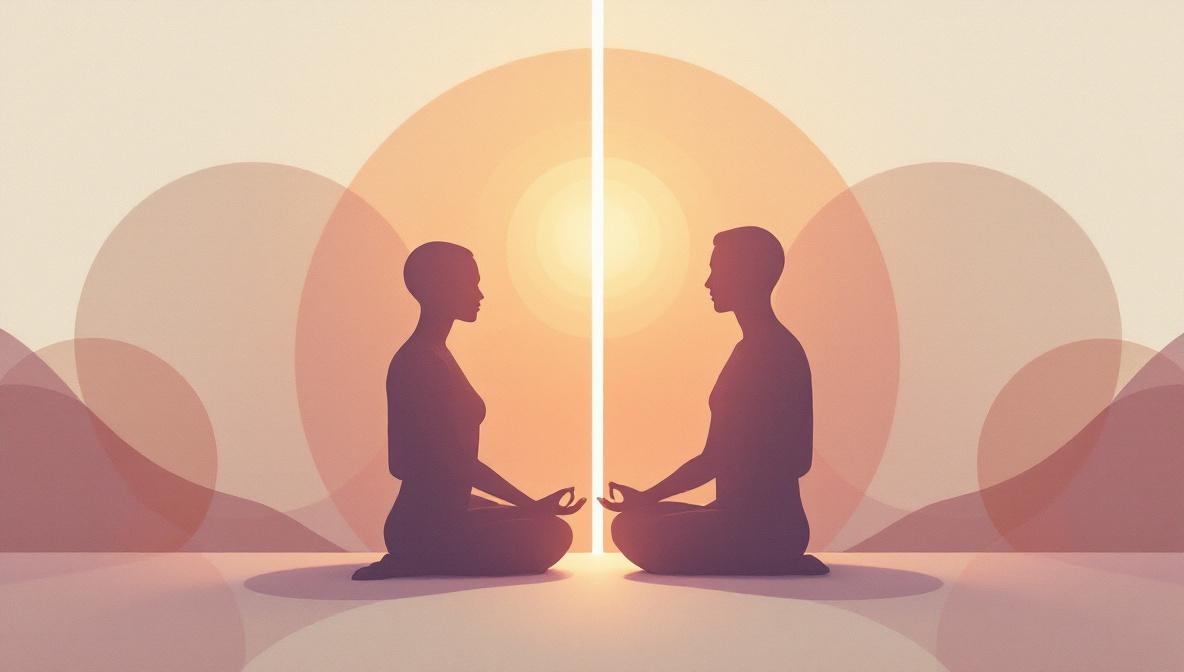
Reiki is a receptive practice — you lie down, receive energy, and let your body do the processing. ThetaHealing® is an active practice — you engage in conversation, identify specific subconscious beliefs, and replace them in a guided meditation state.
Think of it this way: Reiki is like a deep reset for your nervous system. ThetaHealing® is like finding and rewriting a line of code that's been running in the background of your mind.
Both are valid. Both are complementary (not medical). They simply do different jobs.
Side-by-side comparison
| ThetaHealing® | Reiki | |
|---|---|---|
| Origin | Developed by Vianna Stibal, USA, 1995 | Developed by Mikao Usui, Japan, 1922 |
| What it targets | Subconscious beliefs and emotional patterns | Energy flow, physical tension, nervous system balance |
| Your role | Active — you talk, answer questions, engage | Receptive — you lie still and receive |
| Practitioner's role | Guides you into theta state, identifies beliefs through "digging," facilitates replacement | Channels universal life energy through hand positions on or near your body |
| Session length | 45–60 minutes | 60–90 minutes (in person); 45–60 minutes (distance) |
| Physical contact | None (conversation-based) | Light touch or hands hovering (in person); none for distance |
| Works online? | Yes — equally effective via video call | Yes — distance Reiki is a core part of the tradition |
| Best for | Recurring patterns, limiting beliefs, specific blocks | Stress, physical tension, general relaxation, emotional overload |
| Scientific evidence | Very limited — few formal studies | Limited but growing — small studies on relaxation, pain, anxiety |
How to decide which one to try first
You don't need to pick one forever. Many people try both and keep whichever resonates. But if you're choosing your first session, here are practical guidelines.
Start with Reiki if:
- You're physically tense or exhausted and want something that requires zero effort from you.
- You want to try energy work without talking about your life or emotions with a stranger.
- You're going through a high-stress period and need your nervous system to settle.
- You've never done any kind of holistic practice before and want the gentlest possible introduction.
Start with ThetaHealing® if:
- You can identify a specific pattern that keeps repeating — in relationships, money, self-worth, career.
- You've done talk therapy and want to work on beliefs at a deeper-than-conscious level.
- You're comfortable with conversation and introspection as part of the process.
- You want something that targets a specific issue rather than offering general relaxation.
Can you do both?
Yes — and many people do. The two practices don't conflict. A common pattern is to use Reiki for regular nervous system maintenance (monthly or as needed) and ThetaHealing® for targeted belief work when a specific issue surfaces.
Some practitioners are trained in both and can blend techniques within a session. If that interests you, ask the practitioner directly whether they hold certifications in both modalities.
What neither practice can do
This matters as much as what they can do. Neither ThetaHealing® nor Reiki is designed to:
- Diagnose or treat medical conditions
- Replace psychotherapy, psychiatric medication, or medical treatment
- Guarantee any specific outcome
- Work as a one-time fix for deep, complex issues (both benefit from multiple sessions)
Any practitioner — of either modality — who promises cures, diagnoses, or guaranteed results is operating outside the ethical boundaries of their practice. Walk away.
Ready to explore?
Holistic Unity connects you with verified practitioners for both ThetaHealing® and Reiki — online, worldwide.
Browse TherapiesSources and references
- ThetaHealing® Institute of Knowledge (THInK): ente certificatore ufficiale, fondato da Vianna Stibal nel 1995 — thetahealing.com.
- International Center for Reiki Training (ICRT): founded by William Lee Rand, one of the largest international Reiki training organizations — reiki.org.
- US NIH NCCIH on Reiki: overview, evidence base, and safety information — nccih.nih.gov/health/reiki.
- Theta brain waves and meditation: Aftanas LI, Golocheikine SA. “Human anterior and frontal midline theta and lower alpha reflect emotionally positive state and internalized attention: high-resolution EEG investigation of meditation.” Neurosci Lett. 2001; 310(1): 57-60.
- Historical origins: Reiki was developed in 1922 by Mikao Usui (1865-1926) in Japan; the modern global tradition derives largely from the lineage of Hawayo Takata (1900-1980).
Frequently asked
Can I do both ThetaHealing® and Reiki?
Yes. Many people combine both. Reiki supports physical and energetic relaxation, while ThetaHealing® addresses specific belief patterns. They complement each other well.
Which is better for anxiety — ThetaHealing® or Reiki?
Both can help, in different ways. Reiki helps calm the nervous system through deep relaxation. ThetaHealing® works on the subconscious beliefs that may be driving the anxiety. If your anxiety feels physical (tension, racing heart), try Reiki. If it feels mental (looping thoughts, specific fears), ThetaHealing® may be more targeted.
Is ThetaHealing® or Reiki more scientifically proven?
Neither has strong large-scale clinical evidence. Reiki has more published research — mostly small studies showing benefits for relaxation, pain perception, and anxiety reduction. ThetaHealing® has very limited formal research. Both are complementary practices, not replacements for medical care.
Which practice is better for a first-timer?
Reiki is often a gentler entry point because it requires no verbal participation — you simply lie down and receive. ThetaHealing® requires more active engagement. If you want something low-effort and calming, start with Reiki. If you want to address a specific pattern or belief, start with ThetaHealing®.